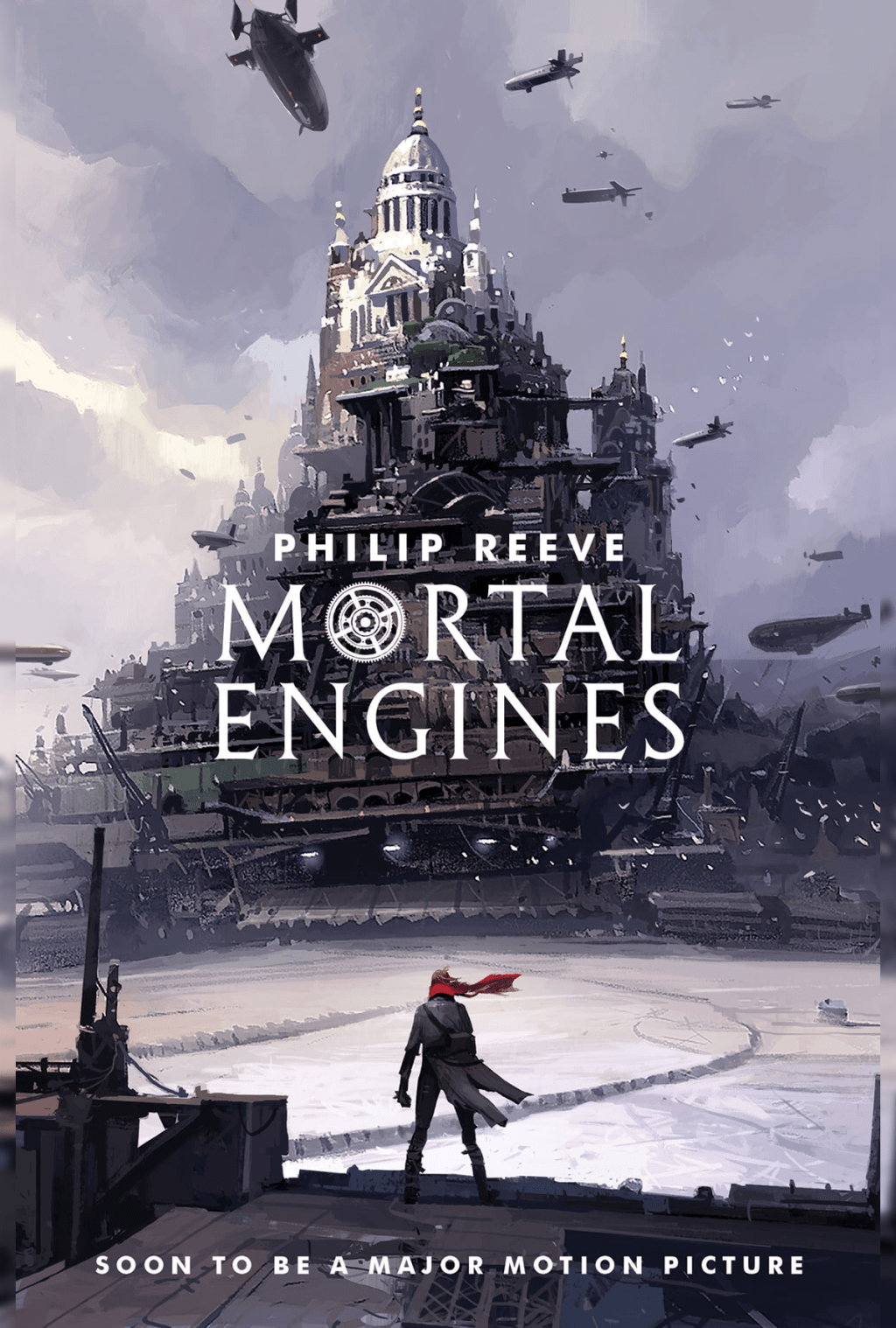
Mortal Engines Quartet (2001 – 2006)
Written by Philip Reeve
“Hesteeeer!!!” I still remembered his rasp voice, ringing in my head even after the movie ends. The image of Shrike persisted on. The cyborg zombie that had bought my heart completely. In the midst of the big superhero movies that came in 2018, I was surprised to find myself sitting in a cinema to watch a movie that many had forgotten it even existed. Released around the same time with Spider-Man: Into the Spiderverse (2018) and Aquaman (2018), Mortal Engines (2018) stood no chance against its bigger competitor.
I was one of the few people who chose to watch Mortal Engines instead of Spider-Man when it first came out. Back then, I used to dedicate a day of my week in the cinemas. And I happened to come across Mortal Engines without prior knowledge on what the entire movie was all about. The movie was one of the greatest blessings I ever had in my life. I fell in love with the world that Philip Reeve had built. And that is without a doubt partly due to how beautiful Peter Jackson had portrayed it in his movie.
Mortal Engines
Skip 5 years later, I begun to read the books that Philip Reeve had written. To be honest with you, I was rather disappointed at first. It took me almost two months to finish the first book. I wasn’t liking it very much. Reading the first book, I couldn’t help but notice how disastrous the writing was. I was considering to drop the entire quartet because the writing was too haphazard. I had expected much more from Mortal Engines. I yearned for the depth of the world, the concept of Municipal Darwinism, and the politics behind the two large factions of the world. Often, I criticised and laughed at how childish the writing was. Many plot points were over-simplified. Many events were glanced through. And the characters were rather dull. Worst of all, there are too many sub-plots. There were little exploration on the different aspects of the world I was excited about. When I finished the first book, I had to sit down and re-watch the movie once again to re-kindle my love for the world. Only to realise that the story in the movie was even worse than the book’s.
Well at that point I had to ruminate. I went to see the first book with a different view. Instead of taking it as it is, I’d ask myself, what was Philip trying to do or trying to convey on certain scenes. I treated it like a literature lesson. Only then I noticed the moral and the messages he was trying to send. The destruction of London in the first book for instance: Philip was trying to convey how greed destroys mankind. Something he portrayed over and over again. Take, the death of Chrysler Peavey on the Black Island. It was only then I could start to appreciate the characters he was building, particularly Hester. I came to appreciate Philip’s ambition. “If only he’d be more concise with the plot and not jump-around many sub-plots,” I thought. He’d write much better.
I decided to give the quartet another chance. Especially due to the fact that I already have the books in my collection to begin with. So I peered into Predator’s Gold. I didn’t regret it at all.
Predator’s Gold
Predator’s Gold proved that Philip is an excellent writer. I had no idea what happened in the span of 2 years, but it seemed that he had finally internalised his vision on the story he wanted to tell. No more jumbled mess of sub-plots. Instead, he gave us an engaging story about Hester’s relationship with Tom. A much simpler story compared to the first book. Grounded and less ambitious. But a page-turner.
Predator’s Gold is filled with many memorable characters and memorable settings. The Lost Boys is one of my favourite faction in the quartet due to their simple but empathetic background. Characters like Nimrod Pennyroyal left me wanting to know more of the character at the end of the book.
The story revolved around a romance (which is rather hard to fail given the Young Adult genre). It added so much layer to the Tom-Hester dynamic. We get to delve deeper into Hester’s and Tom’s psychology. Something that Philip had done with finesse and mastery. It never failed to mesmerise me throughout the quartet.
Infernal Devices
Infernal Devices skipped into the future when Tom and Hester were married. Here, the quartet had a shift in main character which surprised me. Wren Natsworthy—Tom and Hester’s daughter—is our main protagonist in Infernal Devices. And usually these sort of change could be a downer for many readers. But Philip managed to balance the roles of Wren and her parents in the story well. As much as Wren was taking the spotlight, Hester and Tom never left it.
I would consider Infernal Devices as “part 1” of the final book in the quartet. I am impressed in Philip’s execution of the third book. He seemed to have a clearer vision on how he wanted to end his story. While building Wren into one of the most lovable character in the quartet, Philip sets a stage for the finale of his quartet. There are so many moments in the book that leaves you wanting more. Mysteries to solve and adventures to finish.
So… the entirety of book 3 is a set up for book 4? No. Book 3 is Wren’s story. And it is one of the better coming of age stories that I have ever read. It completed Wren’s first arc as a character and at the same time increased the stakes of the entire quartet as it approached its end. I am sure in the future, I would look back to Infernal Devices when I need some inspiration to a good coming of age story.
A Darkling Plain
Without a doubt, the best book in the entire quartet. A Darkling Plain is a culmination of the characters that Philip had been building for the past 3 books. Everything came together in this book in the most unexpected ways. Every relationships. Every sub-plots. Every minute details that he had hinted throughout the quartet. It all came crashing together, forming an incredible mixture of emotion.
A Darkling Plain tied up all character arcs. Not only the main characters, but also every other characters he introduced in the quartet. Our four main viewpoint characters: Tom, Hester, Wren, and Theo. Also the other characters that had in one point of the quartet’s tenure became a viewpoint character. Anna, Shrike, Freya, Caul, Fishcake, Naga, Oenone and of course, Pennyworth. Their stories come to an end. And each of them taught me valuable life lessons.
It was such a satisfaction to see how every character evolves throughout the quartet. Their ups and downs and how their psychology changes as they grow. How their stories interweaved with one another, resulting in a wonderful climax. Even with the underperforming first book, A Darkling Plain elevated the entire quartet. In fact, due to A Darkling Plain, Mortal Engines (Book 1) became much better.
When it comes to A Darkling Plain, it has one of the most satisfying ending to a series that I’ve ever read. The book didn’t shy away from its gritty nature, embracing it even towards the end. The ending to the quartet was one of sadness and grief. Yet, it was beautiful and hopeful. Such emotion was one of a kind for me and I had yet see it replicated in other movies or books I’ve consumed so far. If there’s one thing to learn from Mortal Engines Quartet, it would be to leave a thought-provoking and satisfying ending. One that lingered in your mind for the years to come.
Hester Shaw
Before I end this post, I’d like to talk about my favourite character in the quartet, Hester Shaw. I had one of the most interesting reader-character relationship with Hester. At first, I hated her. She was one of the most useless character in the quartet. Most of the time, she ended up injured and gets saved by another character. She was this damsel in distress disguised as a Mary Sue. And it was frustrating. Her character talks in a mean and condescending way, yet she didn’t even do anything that helps Tom. I wondered why Philip would write such a character.
When I read the book, I realised one major and important difference between Hester in the books and in the movie. Hester is supposed to be ugly, so ugly that it caused her a lot of issues in her life. Hester is this character who has a huge insecurity about how she looks. Due to that, she developed this strong pretentious persona. Something that emanate an aura that she could do everything by herself. This is something that the movie failed to depict. I mean… look at Hera Hilmar who portrayed her. She’s pretty.


Hester’s insecurity becomes her fundamental flaw as a character. And it is what makes her character so interesting. Often, I questioned Philip’s decision. Why would he make a character whose entire motive is to live for someone else (Tom in Hester’s case). Doesn’t it feel lackluster? But my judgment was only proof that I have a long way to go as a writer.
To understand and appreciate Hester Shaw, we’d have to think in her perspective. She is a woman who used to be loved and had a great life. One night was all it took for her to lose everything. Nobody was there for her ever since. People despised her for how she looked. The only person in her life was a literal corpse. All her life, she sought revenge against a certain man. Not only for the death of her mother, but also in a way, for condemning her to live such a life. And in the most unexpected way, in her pursuit of revenge, she found someone who finally love her for who she was. If you are Hester, wouldn’t you do anything for Tom Natsworthy?
It didn’t take a short while for her to heal from this insecurity either. Throughout the quartet, Hester was plagued with the idea that Tom would leave her. And it is in that fear that she was driven to do dark things. Sometime in Predator’s Gold, Hester learned of her lineage, which worsened her insecurity. How would you react when you learned that your father was the man who killed your mother? And that you’ve spent your entire life trying to murder your own father? Such a thought was the very thing that made Hester despised herself. To know and understand that she was alike her father after all.
At the end of Infernal Devices, her insecurities got the better of her. She became obsessed with the idea that people hated her because she carried her father’s blood. And more so, she accepted that people had all the right to hate her. It was sort of a self-suggestion, justifying all her evil actions using this notion. Telling herself that it was all okay because people will hate her anyway. By the end of Infernal Devices, her worst fear became reality. When Tom questioned her morals, and afraid, she ran away, unable to face herself. Unable to face what she had become in Tom’s eyes.
And through all the pain and suffering and the notion of dying alone. How much does it take for a Hester Shaw to finally become the Black Angel, roaming over Zagwa and becoming her own father?

It was saddening to see what Hester had become in A Darkling Plain. She lost everything and she was only waiting to die. But there were hints of kindness in her. The kindness that us, the readers, knew she was capable of. She shared it with Theo, and the boy became the small hope she had to make amends for her sin.
I realised how much I cared for Hester Shaw. She wasn’t the Mary Sue character I thought she was when I first saw the movie. She was one of the most humanised character I’ve ever read. A character with a big flaw and it made you keep on wanting to root for her. Hoping that she could do better and do the right thing.
I was happy for her at the ending of the quartet. Sad and happy. I’m glad that when she died, she had already forgiven herself. I’m glad that she died knowing that Tom had never hated her, and he’d always love her no matter what. But most importantly, I’m glad that she didn’t die alone.
When your death comes, I will have you resurrected, as we agreed long ago. But I can wait. I want to see you live again and be happy.
Shrike — Mortal Engines Quartet: A Darkling Plain
 Joshua Dharmawan
Leave a comment