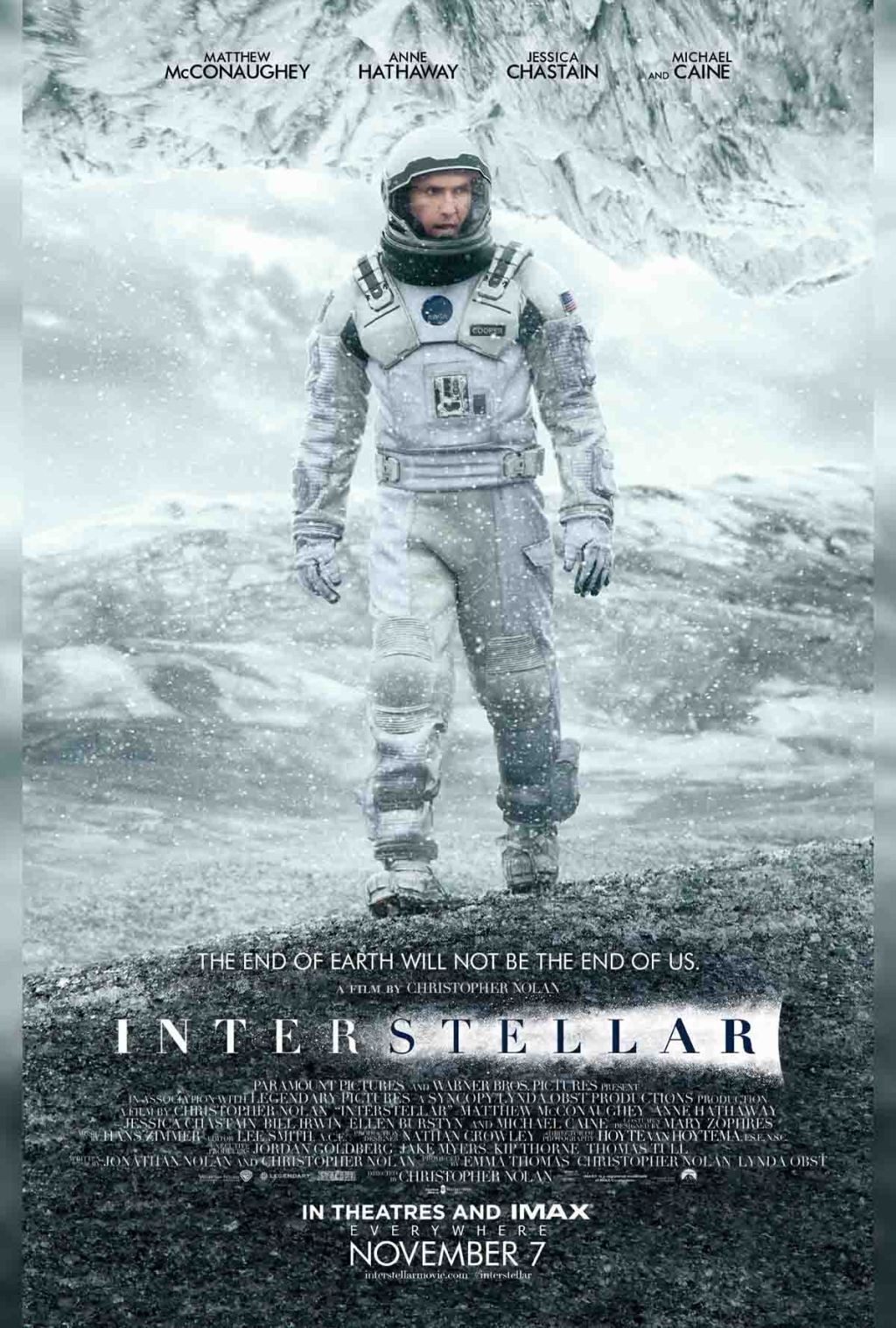
Interstellar (2014)
Directed by Christopher Nolan.
Christopher Nolan became a sensation in the early 2010s due to the critical success of The Dark Knight and Inception. During this time, the superhero genre were booming due to Marvel releasing their first Avengers movie which I believe truly marked the beginning of the Superhero movies era. Back then, I was just as hyped as anyone else for any superhero movies and the only movie I was looking forward to from Nolan was the final movie in his Dark Knight Trilogy—The Dark Knight Rises.
I watched The Dark Knight Rises twice. Once alone on the first day the movie is released—I could not contain the hype—the second time with my dad. Dad was a huge fan of the Dark Knight Trilogy. Honestly, I am not surprised. Nolan’s The Dark Knight is arguably the best superhero movie of all time. His storytelling and cinematography was distinctively unique compared to the other players in the Superhero movie industry—back then it was Sony with their Spiderman franchise and the future king, the Marvel Cinematic Universe. Unlike other Superhero movies, Nolan’s Dark Knight Trilogy was grounded, filled with practical effects that enhanced the sense of realism for its viewers. In fact, it is this very sense of realism that became the main appeal of the Dark Knight Trilogy to me, and without a doubt, to my dad. Dad and I love the Dark Knight Trilogy because it gave us the sense of illusion that a character like Batman could indeed be real.
Coming out of the cinema, that was when my dad had told me how incredible Nolan was as a director. I was intrigued by his comments. Up to that day, I had never watched any of his movies besides the Dark Knight Trilogy. So I decided to give Inception a watch and I was immediately rapt.
Inception was one of the most ingenious movies I have ever watched in my life. It held one of the most interesting premises among the different Sci-Fi pieces I have previously indulged in. What was more amazing was how Nolan would ideate a completely new concept, defining his own rules and followed it throughout until the very end. I admired his work and the complex imagination he had. After Inception I began to pay more attention to his other work and I could not help but wait in anticipation on his future projects.
After The Dark Knight Rises, his next movie that was announced was Interstellar. I was excited for it. I had never really watched a Space movie before that—not even Sci-Fi classic like Star Wars. But I had always been a sucker for Physics (a reason why I pursued a Mechanical Engineering degree). Considering the extent of creativity and thought Nolan had put in Inception, I wondered on the amount of intricacies Nolan would put in his Space-venture movie.
Interstellar came out right after I had graduated from Secondary School. When I watched it, I was overwhelmed by the science that was presented in the movie. My mind would question, “Why does the Endurance is built like a circle and why does it spin? What in the world is time dilation? What the hell is with the paper, pen and the entire thing with the worm hole? And what am I seeing during the climax of the movie?”
Yes, to put it simply. I did not understand anything the movie is talking about.
However regardless of the complexity of the science in the movie, it became, until now, my favourite movie of all time. That is because no matter how complex and abstract this story gets, the essence of its story was delivered with utmost excellence.
Amongst the blackhole, the mountains of water, the stars and the spaceship… In its core, Interstellar is about love. It was represented in various forms, particularly how the protagonists were driven by love to achieve their goals. Brand and her fiancé. Cooper and his daughter. Even the antagonist of the movie—Dr. Mann—acted against the nature of love—driven by his selfish desire. It was hinted in the beginning of the movie, and as the story progresses, it resulted in a climax that revolved around the idea of love—Cooper seeing Murph in the Tesseract.
When I entered the theatre, I did not expect to cry at the end of the movie. But I did. Interstellar merely used the premise of Space Travel and its Sci-Fi genre to essentially tell a love story. Nolan’s writing were focused on delivering this message. And albeit the flashy space scenes and the mind-boggling science, love was still the heart of the story.
After watching Interstellar, I went on to re-watch Inception and only then did I realised that Nolan’s movie always attempted to deliver a powerful message despite their over-the-top premises. Inception was about finding happiness and to be content with what you have. Interstellar was about love—be it romantic or familial. Dunkirk was about survival and hardships. Tenet was about friendship and loyalty (I might need to rewatch Tenet again). Nolan, despite his obsession with the concept of time, understood the essence of a story. I respected and looked up to him for his creativity to create an innovative premise and is able to use it to deliver a powerful message.
From then onwards, every time Hollywood would announce an upcoming Christopher Nolan movie, I would wait for it eagerly. I would keep my eyes opened for the message he was trying to convey rather than the absurdity of his premise. Because if there is indeed one thing he had proven through Interstellar is the importance of the heart of a story.
Love is the one thing we’re capable of perceiving that transcends time and space.
Brand
 Joshua Dharmawan
Leave a comment